


How Should a T-Shirt Fit a Woman Over 50?
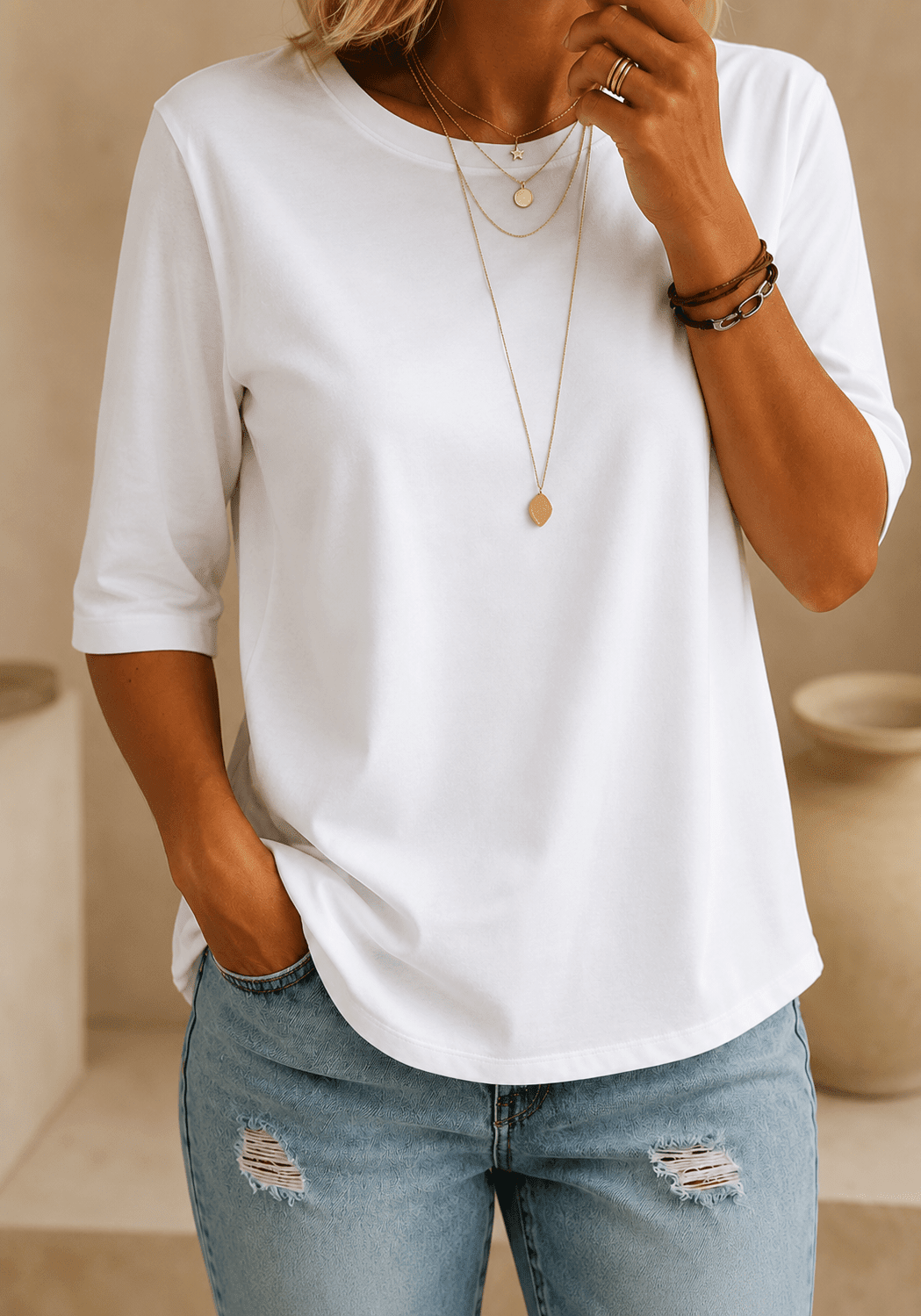
A T-shirt looks like the simplest thing in your closet. But anyone who has bought five "basic" tees and only wears one knows that fit is anything but basic, especially once your shape has changed from the one you had at 30.
The good news: you don't need a different body. You need a T-shirt that fits the one you have. Here's a practical, head-to-hem guide to what good fit looks like, and how to spot it before the tags come off.
The short answer
A well-fitting T-shirt for a woman over 50 should:
- Sit neatly at the shoulders, with the seam at the edge of the shoulder bone
- Have enough room across the bust that the fabric doesn't pull or gape
- Skim the tummy and hips rather than clinging or ballooning
- Have sleeves that end at a flattering point and don't grip the arm
- Finish at a length that suits your torso, usually around the upper hip
- Feel comfortable when you sit, reach and move
Let's look at each in turn.
Start at the shoulders
The shoulders are the foundation of fit, and the hardest part to alter, so judge them first.
- Right: the shoulder seam sits on, or just a fraction past, the edge of your shoulder bone.
- Too small: the seam sits up toward your neck and the fabric pulls across your upper back.
- Too big: the seam drops well down your arm and the sleeves look droopy.
A relaxed-fit tee can have a slightly dropped shoulder by design, but it should still look deliberate, not oversized.
Check the neckline and bust
The neckline should lie flat without gaping or digging in. Lean forward a little in the mirror: if a V-neck falls open more than you'd like, it may be too deep or the tee too large.
Across the bust, look for horizontal pull lines pointing toward the bust. These mean the tee is too tight there. If you have a fuller bust, you may need a relaxed cut rather than a bigger size, which would be too wide everywhere else.
Unsure which neckline suits you? Read Crew Neck vs V-Neck: Which Is More Flattering?
Through the tummy: skim, don't cling
This is where most basic tees let us down. They're often cut quite straight and close to the body, so the fabric outlines the midsection.
What you want is a tee that touches lightly and then falls. Try this:
- Stand side-on to the mirror.
- Look at the line from bust to hem. Ideally, it falls fairly straight down.
- Pinch at the side seam at waist level; you should be able to gather a little fabric without pulling the front tight.
Fabric matters here too. A soft, natural-fiber jersey with some body (such as 100% cotton) tends to drape away from the body; thin, high-stretch fabrics follow every curve. For more ideas, see How to Hide a Tummy in a T-Shirt: 7 Fit Details.
Sleeves: length and width
Sleeves should:
- End at a narrower point of the arm. For many women that's at or just above the elbow.
- Have room to move. If the hem leaves a mark or ridge on your arm, the sleeve is too tight.
- Sit neatly. A rolled or turned cuff gives a tidy finish without extra bulk.
We go deeper in What Sleeve Length Is Most Flattering for Upper Arms?
Length: where the hem should land
For a tee worn untucked, aim for the upper hip, a few inches below your natural waist. Too short, and the hem cuts across the tummy and rides up when you move. Too long, and it can shorten your legs and look shapeless.
Your torso length matters more than your height. If you're often tugging tees down or folding them up, you may need a Petite or Tall fit. Our guide to Petite vs Regular vs Tall shows how to measure.
The movement test
Before you decide, move around in the tee for a minute:
- Raise both arms. Does the hem rise above your waistband?
- Sit down. Does it pull across the tummy or bunch at the hips?
- Reach forward. Does it pull across the back or shoulders?
- Bend over. Does the neckline gape more than you're comfortable with?
A tee that passes all four is a keeper.
Should you size up?
It's tempting to go up a size to avoid cling. But because a bigger size grows everywhere (shoulders, sleeves, neckline and length), it often looks less flattering than your true size in a more relaxed cut. As a rule:
- Size up only if the shoulders or bust are genuinely tight in your usual size.
- Change the cut (to a relaxed fit) if the problem is cling through the tummy.
- Change the length fit (Petite or Tall) if the problem is where the hem lands.
Care affects fit too
Cotton can relax with wear and may change slightly with heat. To keep a cotton tee fitting the way it did on day one, follow the care label. For many cotton tees, including ours, that means machine wash cold and tumble dry low, and avoiding very hot cycles.
A T-shirt designed to fit after 50
The Calvera Essential Comfort Tee was built around this checklist:
- Relaxed fit that skims, rather than clings to, the tummy
- Elbow-length sleeves with a soft rolled cuff that cover the upper arms
- Round or V-neck
- Petite, Regular or Tall length
- Sizes XS–4XL (AU 4–34)
- 100% organic cotton, in 25 colors
It comes with free AU shipping and our 90-Day Fit Promise: if it's not right, swap it or get a refund.
Try the Calvera Essential Comfort Tee →
FAQ
Should a T-shirt be loose or fitted after 50?
Somewhere in between. A relaxed fit that skims the body is usually the most flattering and comfortable. Very tight tees show every line; very baggy ones add bulk.
Where should the shoulder seam sit?
At, or just a fraction past, the edge of your shoulder bone.
How do I stop T-shirts riding up?
Choose a length fit that suits your torso. If your tees always ride up, a Tall fit may help.
What fabric is best for a T-shirt that doesn't cling?
A soft, medium-weight natural-fiber jersey, such as 100% cotton, tends to drape away from the body more than thin, very stretchy blends.